Every Bite Tastes Like Home: A Love Letter to Chole Bhature from the Indian American Table
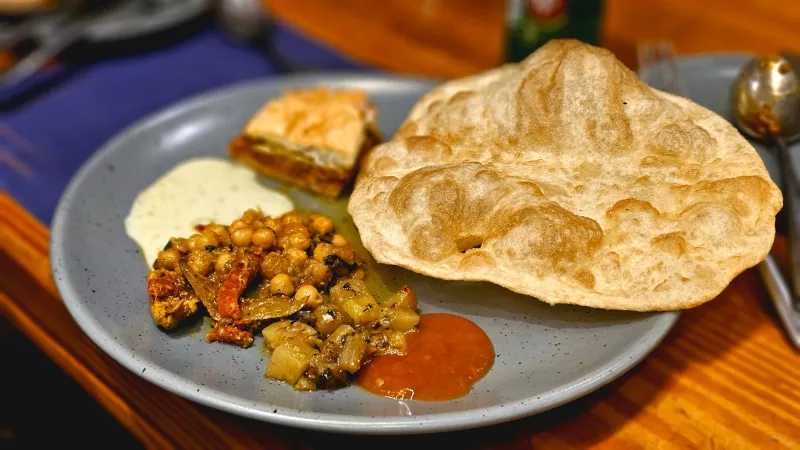
There's a specific kind of Sunday morning that every Punjabi American kid knows. The smell hits you before your eyes even open — that heady, dark perfume of whole spices blooming in hot oil, the faint tang of fermented dough, and something deeply savory that you can't quite name but would recognize anywhere in the world. You stumble downstairs in your pajamas and there's your mom or your nani, already deep in a cloud of steam, rolling out bhature on the kitchen counter while a pot of dark, ink-black chole bubbles away on the stove.
That morning wasn't a special occasion. It didn't need to be.
The Dish That Doesn't Need a Reason
Ask any Indian American what they want to eat after a long week, after a hard day, after a flight back from visiting family in Punjab or Delhi — and nine times out of ten, the answer is chole bhature. Not because it's the fanciest dish in the Indian culinary canon (it's not), and not because it's quick or easy (it really isn't). But because it carries something that's hard to put into words: the specific, irreplaceable comfort of feeling like you belong somewhere.
For the Punjabi diaspora scattered across cities like Fremont, Edison, Naperville, and Sugar Land, chole bhature occupies a place in the emotional landscape that goes way beyond food. It's the dish your parents made when relatives flew in from Toronto or London. It's what showed up at every Diwali potluck in somebody's suburban American living room. It's what you ordered at the one Indian restaurant in your college town when homesickness got unbearable — and it was never quite right, which somehow made you love the real thing even more.
A Street Snack That Crossed an Ocean
Back in Delhi, chole bhature is quintessential street food. It's what you grab at a dhaba near Connaught Place, eaten standing up, sometimes wrapped in newspaper, the chole staining your fingers orange-red while the bhatura balloons in your hands like a golden cloud. The dish has deep roots in Old Delhi's Muslim and Punjabi food culture, likely gaining its modern form sometime in the mid-twentieth century when Punjabi refugees resettled in Delhi after Partition and brought their bold, unapologetic flavors with them.
But somewhere between the dhabas of Paharganj and the strip malls of New Jersey, chole bhature transformed into something different — something more. When you can't get back to the street corner where you first ate it, the dish becomes a vessel for everything you're carrying. The recipe your mother wrote on a folded piece of paper and tucked into your suitcase when you moved to America. The argument you had with your dad about whether the chole needs amchur or tamarind. The way your grandmother's version was darker and more bitter than anyone else's, and how you'd give anything to eat it one more time.
Why This Dish, Specifically?
It's worth asking why chole bhature, out of all the magnificent dishes in Indian cuisine, carries this particular emotional weight for so many people. Part of it is the effort involved. You don't whip up bhature on a Tuesday night — the dough needs time, the chole needs patience, the whole process demands a kind of commitment that signals this meal matters. When someone makes chole bhature for you, it means something.
There's also something about the dish's fundamental generosity. A good plate of chole bhature is abundant. The bhatura is enormous, puffed and dramatic. The chole is rich and complex, layered with spices that took time to develop. It's a meal that says: sit down, stay a while, there's plenty. For families who immigrated with little and built their lives from scratch in a country that wasn't always welcoming, that kind of abundance carries real meaning.
And then there's the social dimension. Chole bhature is rarely eaten alone. It shows up at gurdwara langar halls, at baby showers in community centers, at birthday parties where the kids want pizza but the aunties insist on making the real food. It's a communal dish in the truest sense — something that brings people around a table and keeps them there.
The American Kitchen Adaptation
Here in the US, Indian American home cooks have adapted the dish in ways both practical and creative. Some use canned chickpeas on weeknights when time is short (no shame in that). Others have learned to fry bhature in an air fryer with mixed results — the texture is never quite the same, but the spirit is there. A few have started experimenting with whole wheat flour or adding spinach to the dough, trying to make the dish feel a little lighter without losing its soul.
But the most important adaptations have nothing to do with ingredients. They're about occasion and intention. In America, chole bhature has become the dish that marks transitions — graduations, new jobs, someone's kid getting into college, someone's parent visiting for the first time in three years. It's become a way of saying we made it and we remember where we came from in the same breath.
A Recipe Worth Protecting
There's a real urgency, felt by many in the second-generation Indian American community, around preserving these recipes. Not in a museum-piece way, but in a living, cooking, passing-it-down way. The fear isn't that chole bhature will disappear — you can find a version of it at restaurants from Seattle to Atlanta these days. The fear is that the specific version your family makes, with its particular ratio of spices and its slightly different technique, might not make it to the next generation.
That's why so many of us are in our kitchens on Sunday mornings, calling our moms mid-cook to ask how much tea to add to the chole water, or whether the dough should be this sticky or a little stiffer. We're not just making breakfast. We're holding onto something.
One Plate, Whole Worlds
Chole bhature will never be a trendy dish. It's too honest for that — too tied to specific places, specific people, specific mornings that smelled like home. And that's exactly why it matters. In a country where Indian food is often flattened into a handful of dishes that are expected to represent a billion-person subcontinent, chole bhature quietly insists on its own complexity. It's regional and personal and unapologetically bold.
For Indian Americans, especially those of Punjabi heritage, it's also a kind of anchor. No matter how assimilated your life becomes, no matter how many years pass between visits back to India, there's a plate of chole bhature waiting to remind you who you are and where you come from.
And honestly? That's worth every minute of the frying.