From Three Dollars to Sixteen: What's Really Inside the Price of Chole Bhature
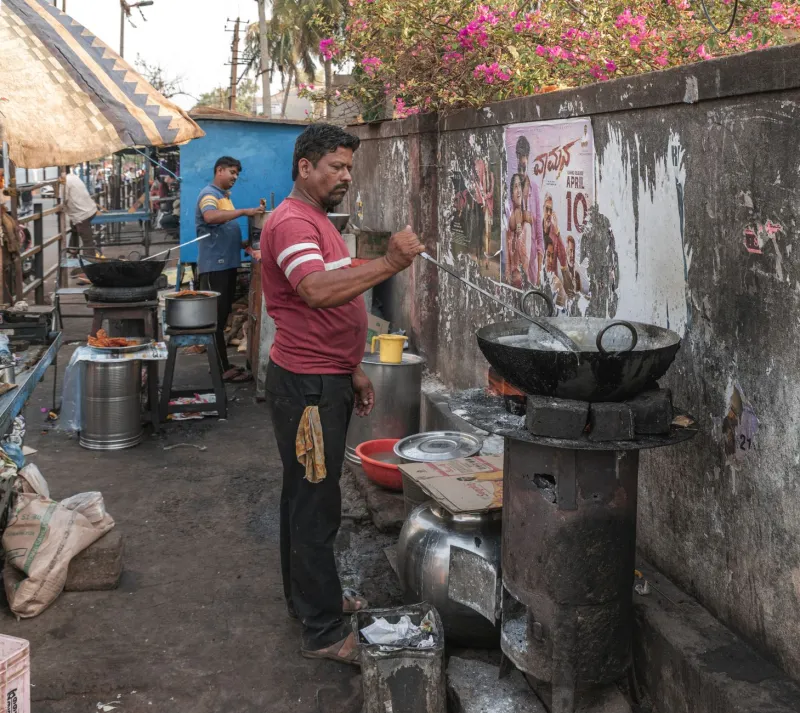
Let's say you're standing at a street corner in Paharganj, Delhi. A guy with a massive blackened kadai, a stack of puffed bhature, and a no-nonsense expression hands you a plate of chole bhature for somewhere around 60 to 80 rupees — call it three dollars on a generous exchange rate. Now fast-forward to a Saturday night at a mid-range Indian restaurant in, say, Naperville or Fremont or Woodbury, and that same dish is listed at $15.99, sometimes $16.99 if there's a pickle garnish and a sprig of cilantro involved.
Same dish. Wildly different price. What's actually going on?
This isn't a complaint piece. It's a genuine breakdown — because understanding what goes into that number tells you a lot about Indian food culture, the economics of street cooking, and what you're actually getting when you make chole bhature yourself at home.
The Street Cart Equation: Ruthless Efficiency in Every Rupee
Street vendors in India operate on margins that would make a Western restaurant accountant cry. Their overhead is almost nothing by comparison. No lease on a commercial space. No POS system. No liability insurance. No server staff. The cart itself is often paid off years before the vendor is still using it.
Ingredient-wise, they buy in bulk — kilos of dried chickpeas, massive tins of oil, wholesale spices that cost a fraction of what you'd pay at a grocery store. A kilogram of dried chickpeas in Delhi might run 80 to 100 rupees. One kilogram, properly cooked, yields enough chole for eight to ten generous servings. That's roughly 10 rupees per serving in chickpeas alone — about 12 cents.
The bhature dough is made from maida (all-purpose flour), a little yogurt, some baking soda, and oil. Again, bought in bulk. The cost per bhature is almost negligible. The real cost on the vendor side is fuel — the oil for frying gets used and reused through the day — and time. And time, for a street vendor, is calculated very differently than it is for a salaried cook.
The vendor's profit on a 70-rupee plate might be 25 to 30 rupees after ingredients and fuel. That sounds tiny. But if they're moving 150 to 200 plates on a busy morning — which is absolutely normal for a popular Delhi cart — the math starts looking reasonable.
What a Restaurant in the US Is Actually Paying For
Now let's talk about that $16 plate. People sometimes assume restaurants are gouging customers on Indian food specifically, but the reality is more complicated and honestly more sympathetic.
Rent for a restaurant space in a US suburb — even a modest one — runs anywhere from $4,000 to $12,000 a month depending on the city. That's before utilities, which spike whenever you're running commercial ovens and deep fryers. Then there's the staff: a line cook, a prep cook, servers, a dishwasher, maybe a manager. Labor laws in most US states mean minimum wage floors that Delhi street vendors simply don't operate under. Health insurance, payroll taxes, workers' comp — all of it adds up.
The restaurant also has to maintain consistency. They're not cooking one batch of chole in the morning and selling it until it's gone. They're plating it at 7pm on a Friday for a table of six who all ordered different things. That requires mise en place, trained staff, and enough inventory to handle a rush without running out.
Food cost in a typical US restaurant runs about 28 to 35 percent of the menu price. On a $16 dish, that means roughly $4.50 to $5.60 actually goes toward ingredients. The rest covers everything else — rent, labor, utilities, credit card processing fees, takeout packaging, and somewhere in there, a slim profit margin.
So the restaurant isn't pocketing $13. They're probably clearing $1 to $2 on that plate if it's a decent week.
The Home Cook Calculation: Where the Real Value Lives
Here's where things get interesting for those of us making chole bhature in our own kitchens.
A pound of dried chickpeas at an Indian grocery store in the US typically runs $1.50 to $2.50. One pound, soaked and cooked, gives you enough chole for four to six people easily. A bag of maida — the flour for bhature — costs around $3 to $4 for five pounds and will last you multiple batches. Spices, if you're already stocking an Indian pantry, add maybe $0.50 to $1.00 per pot of chole.
All in, a full home batch of chole bhature — enough to feed four adults generously — runs somewhere between $6 and $10 in ingredient costs. That's roughly $1.50 to $2.50 per person. Cheaper than the Delhi street cart in absolute dollar terms, though obviously the purchasing power comparison isn't apples to apples.
What you're spending instead is time. Soaking chickpeas overnight. Pressure cooking them to the right texture. Getting the bhature dough to ferment properly so it puffs when it hits the oil. These are skills, not shortcuts, and they take a few tries to feel natural.
But once you've got them? You're eating restaurant-quality chole bhature at street-cart prices, in your own kitchen, on your own schedule.
A Few Ways to Keep Your Home Batch Costs Low
If you want to be strategic about it, here are the moves that actually make a difference:
Buy dried, not canned. Canned chickpeas are convenient, but you're paying a significant markup for that convenience. Dried chickpeas are cheaper per serving, cook up with better texture, and give you more control over the final result.
Shop at Indian or South Asian grocery stores. Whole Foods and mainstream supermarkets charge a premium for the same spices you can get at a fraction of the cost at your local Indian grocery. Cumin, coriander, amchur, and black cardamom are all dramatically cheaper there.
Make a big batch and freeze the chole. Chole freezes beautifully. Bhature don't, but the chole is the labor-intensive part. Make double and freeze half — future you will be very grateful on a Wednesday night.
Fry bhature in batches and eat immediately. The oil cost is real, but if you're already heating a pot of oil, you might as well make a full batch of bhature rather than a small one. The marginal cost of extra bhature is almost nothing once the oil is hot.
The Real Price of Chole Bhature
The economics of this dish are a mirror for Indian food culture broadly. Street food in India exists in a completely different economic ecosystem than restaurant food in the US — different labor costs, different overhead, different expectations from the customer. Neither is wrong. They're just operating by entirely different rules.
When you pay $16 at an Indian restaurant in America, you're paying for a trained kitchen team, a comfortable dining room, and the infrastructure that makes a consistent meal possible across hundreds of covers a week. When you make it at home for $2 a serving, you're paying with your time and your learning curve.
And when that Delhi vendor sells it for three dollars? He's paying with decades of muscle memory, a 4am start time, and an overhead structure that simply doesn't exist anywhere else in the world.
All three versions of chole bhature are worth exactly what they cost. The one you make at home, though — that one's got something the other two can't put a price on.